
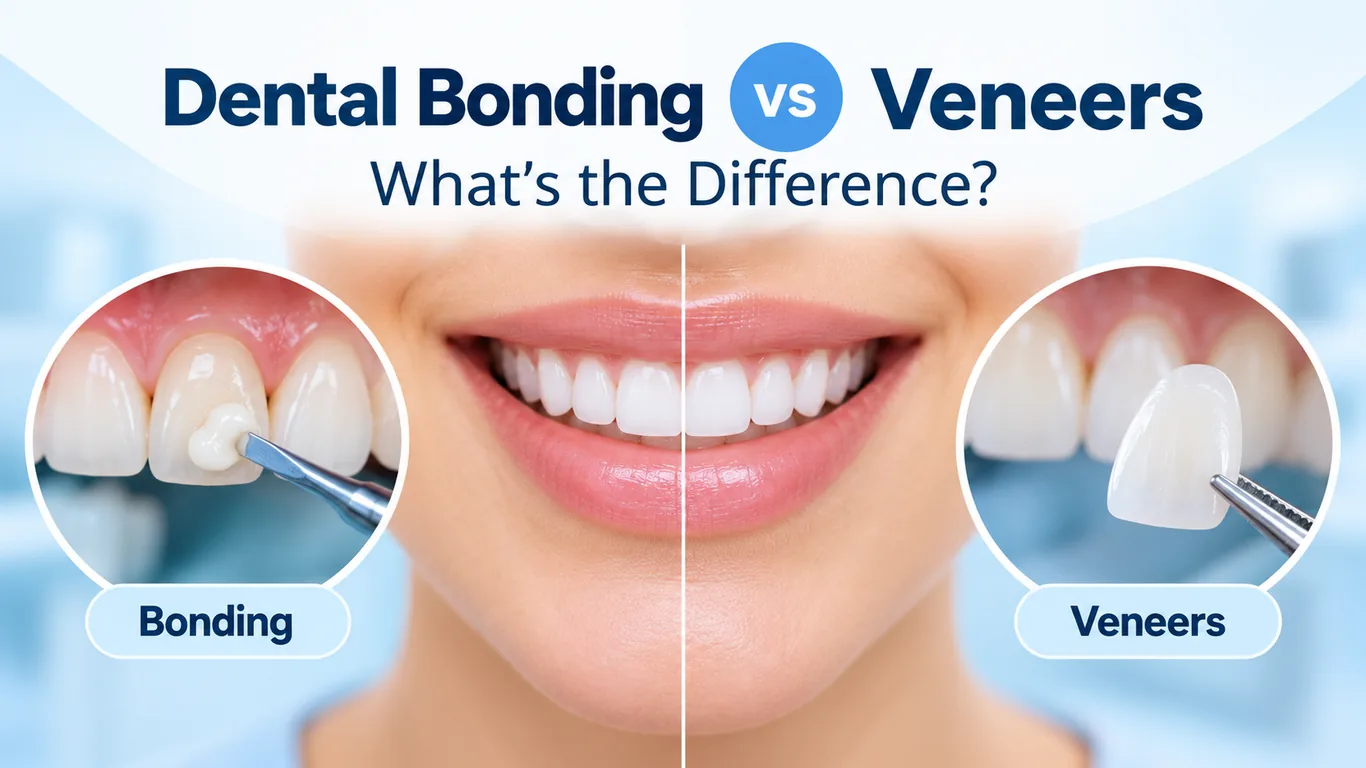
If you want to improve chipped, uneven, discoloured, or slightly spaced teeth, two treatments you may come across are dental bonding and porcelain veneers. Both can change the appearance of a smile, but they use different materials, involve different levels of tooth preparation, and are suited to different cosmetic concerns.
Understanding the difference between dental bonding and veneers can help you have a more informed conversation with your dentist. The right option depends on the condition of your teeth, the amount of change you want, your bite, your long-term expectations, and other individual factors.
If you are considering cosmetic treatment in Richmond Hill, this guide compares dental bonding and dental veneers to help you understand where each treatment may fit.
What Is Dental Bonding?
Dental bonding uses tooth-coloured composite resin that is applied directly to the tooth. The dentist selects a shade, prepares the tooth surface as needed, shapes the resin, hardens it with a curing light, and then adjusts and polishes the material.
Bonding is commonly considered for smaller, localized cosmetic changes, such as:
- Repairing a small chip
- Closing a minor space between selected teeth
- Improving an uneven tooth edge
- Changing the shape of a slightly undersized tooth
- Masking certain localized areas of discolouration
- Repairing selected areas of worn or exposed tooth structure
In appropriate cases, bonding may require little alteration of healthy enamel. However, the exact amount of preparation depends on the tooth and what is being corrected.
What Are Porcelain Veneers?
Porcelain veneers are thin ceramic restorations designed to cover the front surface of selected teeth. They are individually planned for the patient and can be used to change aspects of tooth shape, colour, proportion, and overall smile appearance.
Traditional porcelain veneers usually require removal of some enamel so the restorations can be positioned and bonded appropriately. Because tooth structure is altered, treatment with conventional veneers should generally be considered a long-term commitment rather than a temporary cosmetic change.
Veneers may be considered when a patient wants a broader cosmetic change than bonding can predictably provide, but they are not appropriate for every tooth or every bite.
Dental Bonding vs. Veneers: Quick Comparison
| Consideration | Dental Bonding | Porcelain Veneers |
|---|---|---|
| Material | Tooth-coloured composite resin | Dental ceramic or porcelain |
| How It Is Made | Applied and shaped directly on the tooth | Custom restoration fabricated for the tooth |
| Tooth Preparation | Often limited in suitable cases | Usually requires planned enamel preparation |
| Typical Treatment Scope | Smaller or localized cosmetic changes | More extensive changes in colour, shape, proportion, or symmetry |
| Stain Resistance | Composite can stain over time | Porcelain is generally more stain-resistant |
| Repair | May sometimes be adjusted, polished, or repaired directly | Damage may require repair or replacement of the veneer |
| Number of Appointments | May sometimes be completed in one appointment | Usually requires planning, preparation, and placement stages |
| Longevity | Varies with bite, habits, care, location, and material | Varies with preparation, bite, care, and clinical factors |
There is no universally better option. Bonding may be appropriate for a conservative correction of a small concern, while veneers may be considered when more extensive changes are desired. A dental assessment is necessary before deciding between them.
Which Option Requires Less Tooth Preparation?
Dental bonding is often the more conservative of the two options when only a small cosmetic change is needed. Composite resin can frequently be added directly to the tooth with limited enamel alteration.
Traditional porcelain veneers generally require some enamel to be removed from the front or sides of the tooth before the veneer is bonded. The amount varies depending on the position of the tooth, the desired result, and the type of veneer being used.
This difference matters because enamel that has been removed does not grow back. Patients considering veneers should understand the planned tooth preparation before treatment begins.
Which Looks More Natural: Bonding or Veneers?
Both treatments can produce natural-looking results when appropriately planned and performed. However, they use different materials.
Composite resin can be selected and shaped to coordinate with surrounding teeth. It is useful for smaller corrections and can be adjusted directly during treatment.
Porcelain has optical properties that can closely resemble natural enamel and is generally more resistant to staining than composite resin. This can make porcelain attractive for patients seeking broader changes across several visible teeth.
The final appearance depends on more than the material alone. Tooth position, gumline, smile symmetry, bite, shade selection, and treatment planning all influence the result.
Which Treatment Is Better for Chipped Teeth?
Dental bonding may be a good option for a small chip when the remaining tooth is healthy and there is enough structure to support the composite material.
A larger fracture may require a different restoration. Depending on how much tooth structure has been lost, the condition of the tooth, and the bite, a dentist may recommend a veneer, dental crown, or another treatment instead.
The size of the chip alone does not determine treatment. The dentist also needs to check for cracks, decay, pulp involvement, and bite forces.
Bonding or Veneers for Gaps Between Teeth?
Small spaces between selected teeth can sometimes be reduced with composite bonding by adding material to the sides of the teeth.
Veneers may also be used to change tooth proportions and close selected spaces, especially when other cosmetic changes are being planned at the same time.
However, not every gap should be closed by making the teeth wider. Larger spaces, crowding, bite problems, or tooth-position concerns may be better managed with orthodontic treatment such as Invisalign or braces.
Which Is More Resistant to Staining?
Porcelain veneers are generally more stain-resistant than composite resin. Bonding material can gradually change colour or lose some surface polish, particularly with frequent exposure to strongly staining foods, drinks, tobacco, or other factors.
Bonding can sometimes be polished, repaired, or replaced if appearance changes over time. Porcelain can also eventually require repair or replacement if it chips, cracks, loosens, or develops another problem.
Neither treatment eliminates the need for regular oral hygiene and professional dental care.
Which Treatment Lasts Longer?
There is no guaranteed lifespan for either dental bonding or porcelain veneers.
How long a restoration lasts can depend on:
- The amount and location of the restoration
- The way your upper and lower teeth meet
- Grinding or clenching
- Nail biting or chewing hard objects
- Oral hygiene
- Diet and staining habits
- The health of the underlying tooth
- Accidental trauma
- The materials and clinical technique used
Porcelain generally offers greater stain resistance and may be selected when a longer-term ceramic restoration is appropriate. Composite bonding can be easier to modify or repair, but it may need polishing, repair, or replacement sooner depending on the situation.
What Should I Compare Before Choosing Treatment?
Ask how each suitable option affects healthy enamel, tooth shape, maintenance and future repair. Discuss your bite, grinding habits, the amount of change you want and whether a conservative alternative could address the concern.
A written treatment plan can help you compare clinically appropriate options after an examination.
Which Option Is Better if You Grind Your Teeth?
Grinding and clenching can place additional force on both composite bonding and porcelain veneers. Repeated heavy forces may contribute to wear, chipping, fracture, or other restoration problems.
If you grind or clench your teeth, tell your dentist before cosmetic treatment. Your bite should be assessed, and in some cases your dentist may recommend managing the grinding or using a protective appliance.
Neither bonding nor veneers should be selected without considering the forces placed on the teeth.
When Dental Bonding May Be the Better Fit
Bonding may be worth considering when:
- The cosmetic concern is small and localized
- A conservative treatment approach is preferred
- Only minor changes in shape or contour are needed
- A small chip or gap needs correction
- The tooth and surrounding gums are healthy
- The bite is suitable for a composite restoration
Bonding may not be ideal for very large changes, extensive structural damage, severe discolouration, or areas exposed to heavy biting forces.
When Porcelain Veneers May Be the Better Fit
Veneers may be considered when:
- Several visible teeth require coordinated cosmetic changes
- A larger change in tooth shape or proportion is desired
- Colour concerns cannot be adequately addressed with whitening or limited bonding
- Greater stain resistance is an important treatment consideration
- The teeth, gums, and bite are suitable for veneer treatment
Veneers are not simply a stronger version of bonding. They involve different preparation, materials, maintenance considerations, and long-term implications.
Can You Replace Bonding With Veneers Later?
In some cases, a patient who has previously had dental bonding may later consider porcelain veneers. Whether that is appropriate depends on the condition of the teeth, the amount and location of existing composite, the bite, and the desired result.
Existing bonding does not automatically mean veneers are necessary, and changing from one treatment to another should be based on a new clinical assessment rather than cosmetic preference alone.
Can Bonding and Veneers Be Used Together?
Sometimes different teeth require different solutions. A treatment plan may potentially include bonding on one tooth and another type of restoration on a different tooth.
However, combining treatments requires careful planning so that tooth colour, shape, proportions, bite, and the overall smile remain coordinated.
Your dentist can explain whether using more than one restorative or cosmetic approach makes sense for your individual case.
What Should Be Treated Before Cosmetic Bonding or Veneers?
Cosmetic treatment should begin with healthy teeth and gums. Problems such as active decay, gum disease, infection, significant cracks, or other untreated dental conditions may need to be addressed before bonding or veneers are considered.
Your dentist should also evaluate:
- Your bite
- Tooth position
- Existing restorations
- Grinding or clenching
- Gum health
- The amount of healthy tooth structure available
This helps determine whether cosmetic treatment can be performed predictably and whether another option may be more appropriate.
Dental Bonding vs. Veneers: How Do You Choose?
The best choice depends on what you want to change and what condition your teeth are in.
If the concern is small and you prefer a conservative direct restoration, dental bonding may be worth considering. If you want broader changes in tooth colour, shape, or smile symmetry and your teeth are suitable for ceramic restorations, veneers may be another option.
In some cases, neither is the best first treatment. Teeth whitening, orthodontics, fillings, crowns, or another form of cosmetic dentistry may better address the underlying concern.
The goal is not to choose bonding or veneers before an examination. The goal is to identify the least invasive treatment that can reasonably address your concern while supporting the long-term health and function of your teeth.
CDCP and cosmetic treatment
CDCP does not cover cosmetic veneers or whitening. Bonding performed only to change appearance is not automatically eligible. A clinically necessary restorative procedure needs an individual coverage check. Read our CDCP information and official CDCP coverage guidance.
Frequently asked questions about bonding and veneers
Is dental bonding the same as a veneer?
No. Bonding usually involves composite resin applied directly to a tooth. A porcelain veneer is a custom ceramic restoration bonded to the front surface. Suitability and preparation differ.
Does bonding always require less tooth preparation?
Bonding may be conservative, but preparation depends on the defect, existing restorations and treatment plan. Veneers commonly involve enamel alteration; ask what would be changed for your teeth.
Which option is appropriate for a small chipped tooth?
A small chip may sometimes be repaired with bonding. The dentist must first assess the cause, remaining tooth structure and bite. More extensive damage may need another approach.
Can grinding affect bonding or veneers?
Grinding and clenching can increase stress on restorations. Discuss these habits before treatment so your dentist can assess the bite and appropriate protective or alternative care.
Are bonding and veneers covered by CDCP?
Cosmetic veneers and treatment solely to change appearance are not covered by CDCP. A clinically necessary restorative service requires a separate check against the diagnosis, service code and plan criteria.
Patient resources: ODA: Cosmetic Dentistry and CDA: Bonding & Veneers. For informed treatment discussions, see RCDSO: Consent to Treatment. Ask about the expected benefits, material risks, alternatives and implications of declining treatment. These independent resources do not imply approval of this article or endorsement of this clinic. This guide is general information and does not replace an individual assessment.
Considering Dental Bonding or Veneers in Richmond Hill?
If you are comparing dental bonding and porcelain veneers, a consultation can help clarify which option may be appropriate for your teeth, bite, cosmetic goals, and long-term expectations.
Mackenzie Smiles Dentistry provides cosmetic dentistry assessments by general dentists for patients in Richmond Hill. A dentist can examine your teeth, discuss the changes you would like to make, and compare bonding, veneers, and other suitable treatment options.
Book an appointment with Mackenzie Smiles Dentistry to discuss your options.
