
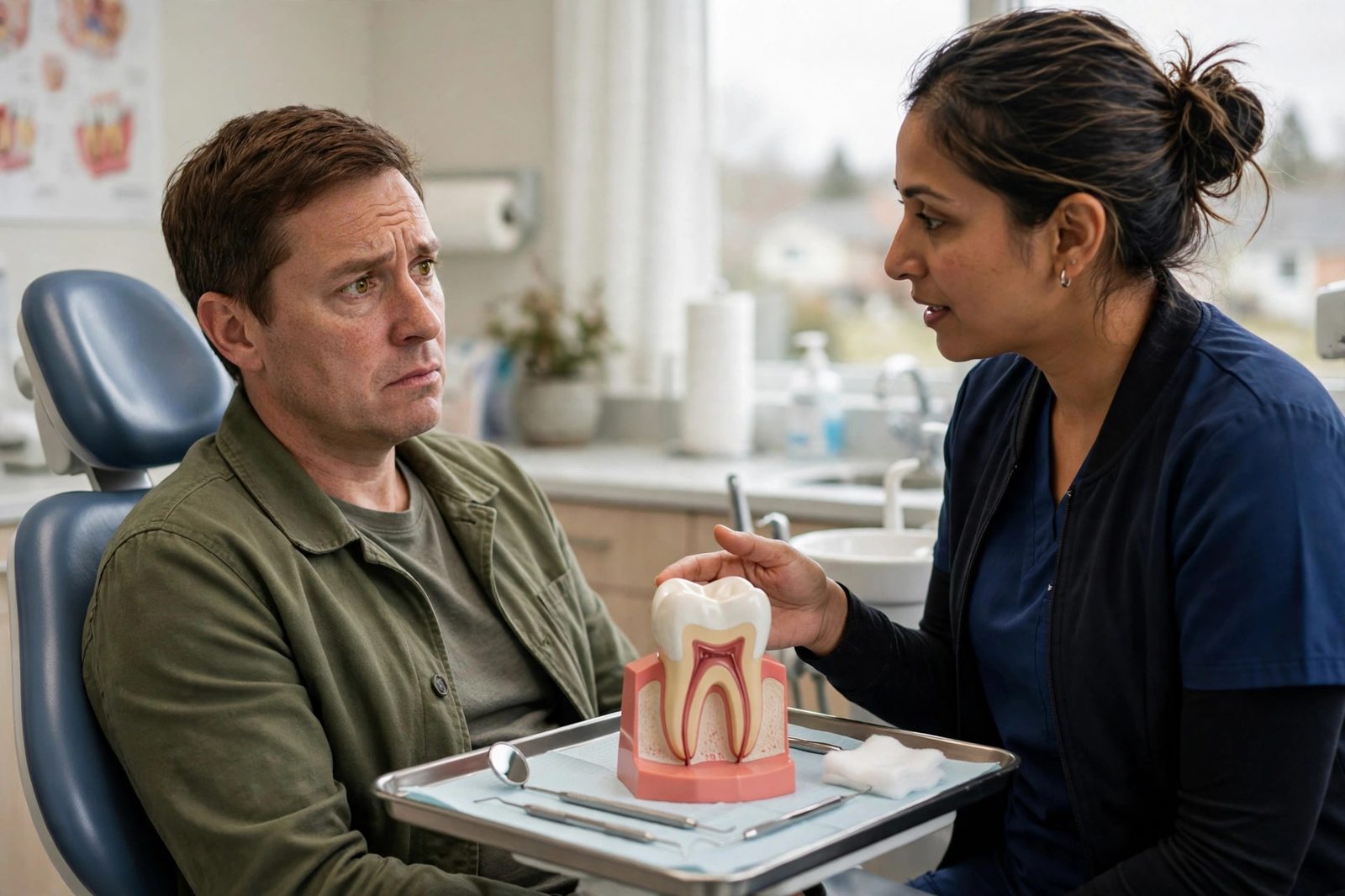
Root canal vs extraction in Richmond Hill is the decision patients face when a tooth is deeply infected or badly damaged. One path keeps your natural tooth; the other removes it — and then the question becomes what replaces it. This guide from Mackenzie Smiles compares both honestly, including the cases where saving the tooth is the wrong spend. It supports our root canal therapy in Richmond Hill page, and our tooth extraction page covers the removal side in detail.
What each option is
Root canal treatment removes the infected or damaged nerve tissue from inside a tooth, disinfects the canals, seals them, and usually finishes with a crown to protect what remains. The tooth stays in your jaw, minus its living nerve. Extraction removes the whole tooth, root and all. After healing, the gap can be left, or filled with an implant, a bridge, or a partial denture — each with its own timeline and care. A fair comparison therefore is not root canal versus extraction alone; it is root canal plus crown versus extraction plus whatever replaces the tooth.
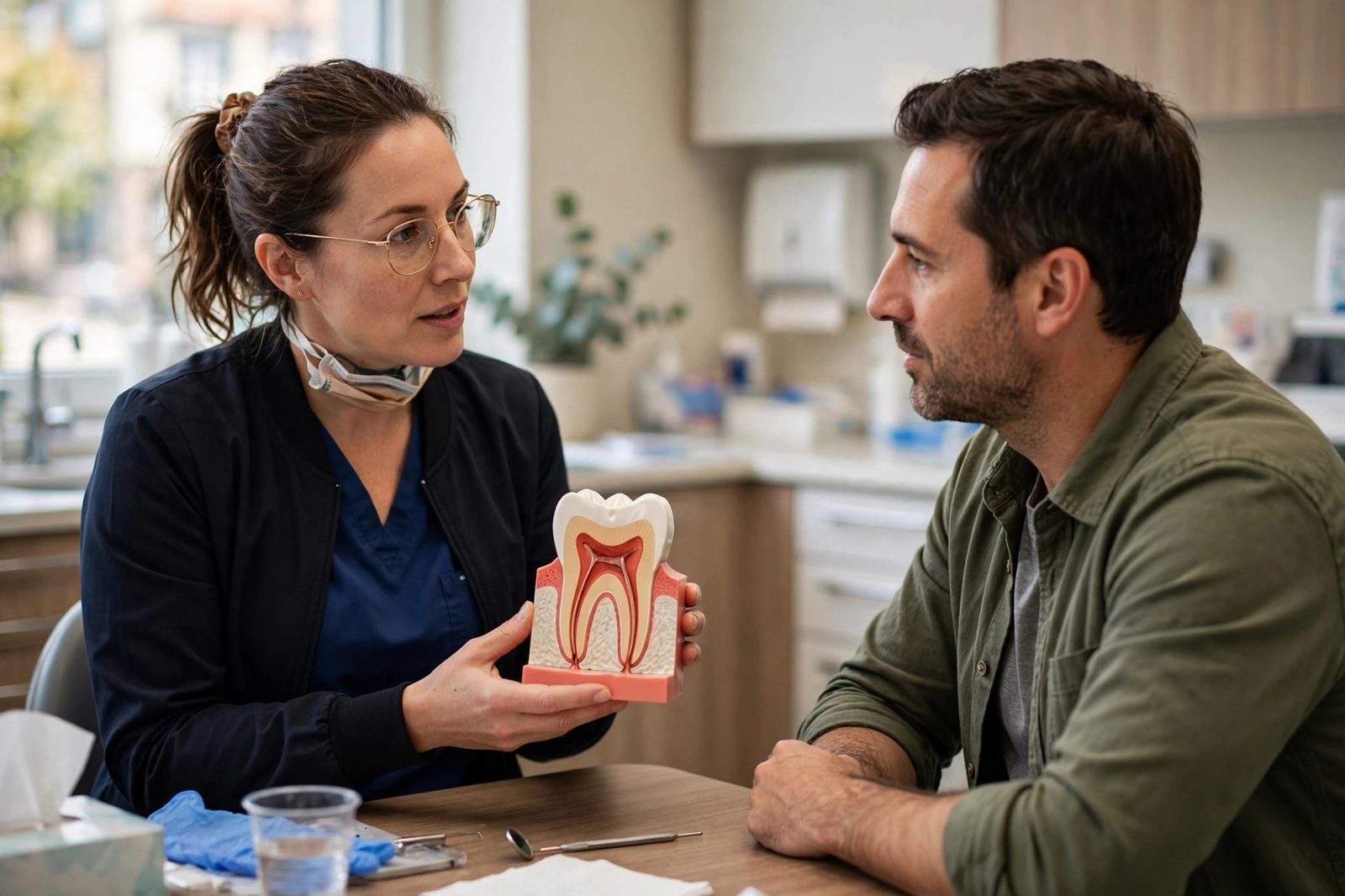
Side-by-side comparison: root canal vs extraction
| Question | Root canal treatment (save the tooth) | Extraction (remove the tooth) |
|---|---|---|
| What it is / how it works | The infected pulp is removed, canals are cleaned and sealed, and the tooth is rebuilt — usually with a crown. Your natural root stays and keeps working. | The entire tooth is removed under local anaesthesia. The socket heals over a few weeks; replacement, if wanted, is a separate treatment afterwards. |
| Typical lifespan | Ng and colleagues (International Endodontic Journal, 2010) reported that roughly 8 to 9 in 10 root-treated teeth were still present and functioning years after treatment, with survival of the treated tooth — not just the filling — as the measured outcome. A protective crown and good hygiene improve the odds. | Extraction is permanent and has no lifespan to measure — the tooth is gone. What needs a lifespan discussion is the replacement: implants and bridges carry their own long-term figures, discussed at the planning visit. |
| Maintenance and care | Normal brushing and flossing, with care at the crown’s edge, where new decay is the main long-term threat. The tooth no longer feels temperature, so checkups and X-rays watch it. | Aftercare for the socket in the first days (soft foods, no smoking, gentle rinsing as directed), then normal care for the remaining teeth — plus whatever maintenance the replacement needs. |
| Effect on neighbouring teeth and jawbone | Neighbouring teeth and the jawbone are undisturbed; your own root keeps the bone loaded and your bite unchanged. | The bone in the socket shrinks after removal, and neighbouring teeth can drift toward the gap over time while the opposing tooth over-erupts. Replacing the tooth — especially with an implant — counters most of this. |
| Who it suits and who it does not | Suits a tooth with a sound root, enough remaining structure for a crown, and healthy supporting bone. It does not suit a tooth split through the root, decayed far below the gumline, or too mobile from gum disease — treating those is spending on a tooth that cannot last. | Suits teeth that cannot predictably be saved, badly fractured roots, and some severely crowded or impacted teeth. It is a poor choice for a tooth that could have been saved predictably — removal is irreversible, and replacement costs more than saving usually does. |
| Number of visits and timeline | Often one to two visits for the root canal itself, then a further visit for the crown a few weeks later. | Usually a single visit for the removal; healing takes a few weeks. An implant replacement then runs over months; a bridge or denture over weeks. |
| CDCP coverage | Root canal treatment may be covered under the CDCP for eligible patients, subject to plan rules and, for some teeth, preauthorization. Eligibility comes first, and coverage is never 100% of every fee. | Extractions may be covered under the CDCP for eligible patients. Note the follow-on: dental implants and fixed bridges used to replace the tooth are not covered by the CDCP. |
How to choose
Ask about the tooth’s structure, not just its symptoms. Pain and infection tell you the nerve is involved; they do not tell you whether the remaining tooth can hold a crown for years. If the root is sound and enough tooth remains above the gum, saving it is usually the better value — one treatment, your own tooth, nothing to replace. If the tooth is cracked through the root or mostly filling and hope, extraction is the honest answer, and the replacement plan should be made at the same time, not discovered later. At Mackenzie Smiles, sedation means nitrous oxide only — if anxiety is part of your decision, ask us how nitrous works and whether it suits you. Patients who need a CBCT scan are referred out for that imaging; we will arrange the referral and work from the results.
Factors that affect cost
We do not publish prices, because the honest comparison depends on the tooth: molars have more canals than front teeth, a crown is usually part of the saving plan, and extraction’s true figure includes the replacement you choose. At your assessment you receive an exact written quote for each full path — save, or remove and replace — before you decide. Call Mackenzie Smiles in Richmond Hill at (905) 237-2353.
Frequently asked questions
The tooth is fully frozen with local anaesthesia first, and most patients are surprised that the appointment feels like a long filling. We will not promise a pain-free experience — the tooth often aches for a few days afterwards as it settles — but the infected tooth usually hurts more before treatment than after. Nitrous oxide is available at our clinic if anxiety is your main concern.
Ng and colleagues (International Endodontic Journal, 2010) found roughly 8 to 9 in 10 root-treated teeth still present and functioning years later. The crown protecting the tooth, your bite forces, and decay control at the crown edge are the main factors in how long yours lasts.
Sometimes very little, for a back tooth with a stable bite — but commonly the neighbouring teeth drift, the opposing tooth grows down into the gap, chewing shifts sides, and the bone in the gap shrinks. Those changes are slow and largely one-way, which is why we discuss replacement at the extraction visit, not years later.
An active dental infection should not wait. Pain that settles on its own is not proof the infection is gone — it can mean the nerve has died while infection continues at the root tip. Swelling, fever, or trouble swallowing are same-day problems: call us promptly.
The extraction appointment alone usually costs less than root canal plus crown — but that comparison leaves out replacing the tooth. Extraction plus an implant or bridge is generally the more involved path overall. We quote both complete paths in writing so the comparison is honest.
Both may be covered for eligible CDCP patients, under plan rules and sometimes preauthorization, and never at 100% of every fee. The replacements differ: implants and fixed bridges are not covered. We will check your eligibility picture before treatment.
Yes, occasionally — a canal can be missed, anatomy can be unusually complex, or new decay can re-contaminate the tooth. Some failures can be retreated; some lead to extraction after all. We will always tell you the realistic outlook for your tooth before you invest in saving it.
Back teeth almost always do — a root-treated tooth is more brittle, and chewing forces can split an unprotected molar. Front teeth with small access openings sometimes need only a filling. Your dentist will explain which applies and why.
Sources and further reading
- Canadian Dental Association (CDA) — patient guidance on dental treatments.
- Ontario Dental Association (ODA) — patient resources for Ontario.
- Canadian Dental Care Plan — Canada.ca — official coverage information.
