
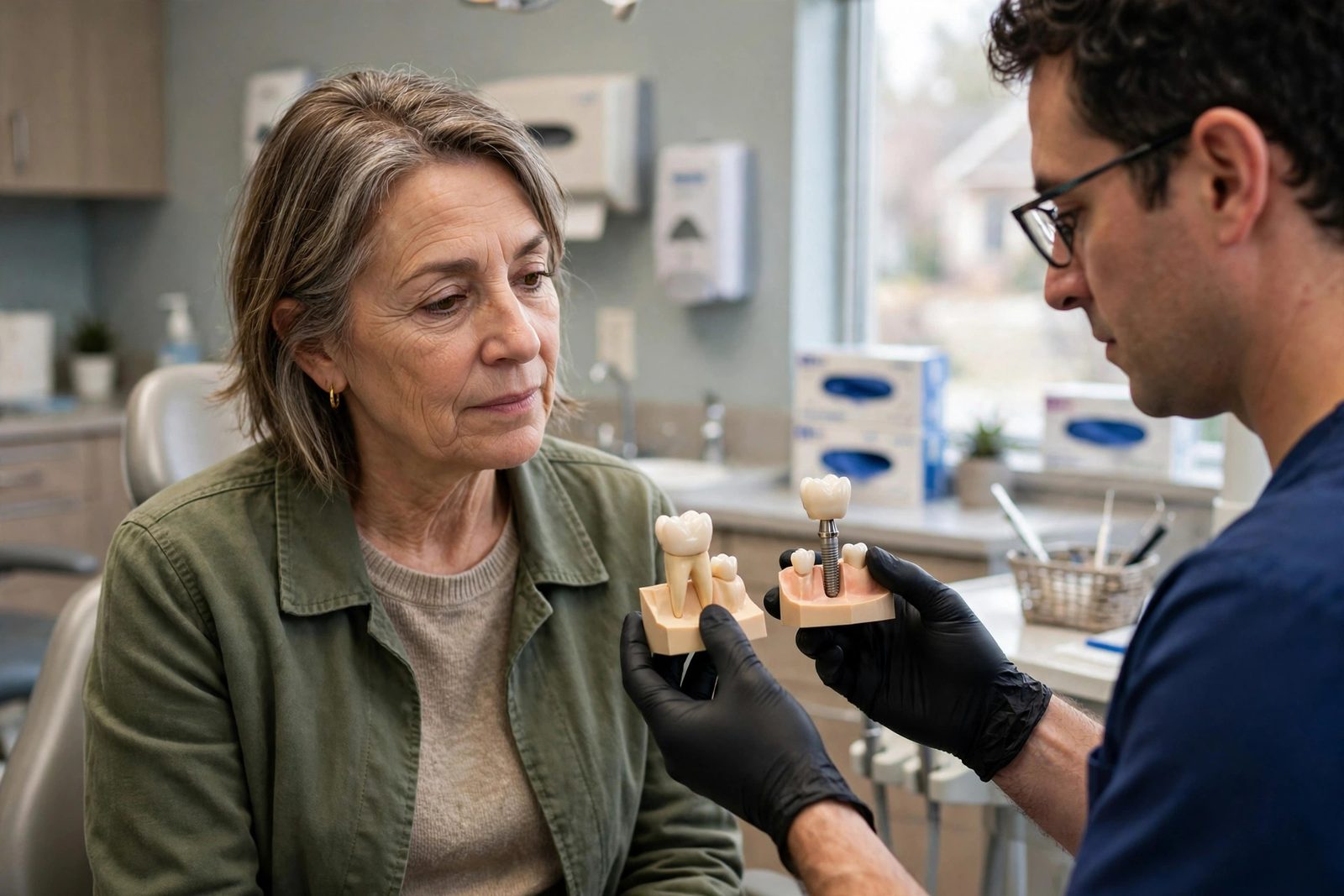
Every crown vs implant decision in Richmond Hill starts with the same question: is there enough healthy tooth left to save? A crown rebuilds a damaged tooth on its own root. An implant replaces a tooth that’s gone — or can’t be saved — with an artificial root and a crown on top. Neither is “better” in the abstract. This guide compares them honestly, including who each one does not suit.
For the replacement side of the picture, see our page on dental implants in Richmond Hill at Mackenzie Smiles, then come back to the comparison.
On this page
The short answer
If the root is healthy and enough tooth structure remains, saving the tooth with a crown is usually the first choice — your own root preserves bone, feeling, and options. If the tooth is cracked below the gum, decayed beyond repair, or already missing, an implant is the option that replaces it without asking neighbouring teeth to carry the load. The dividing line is the condition of the tooth, and it’s drawn at an assessment with imaging — not from symptoms alone.
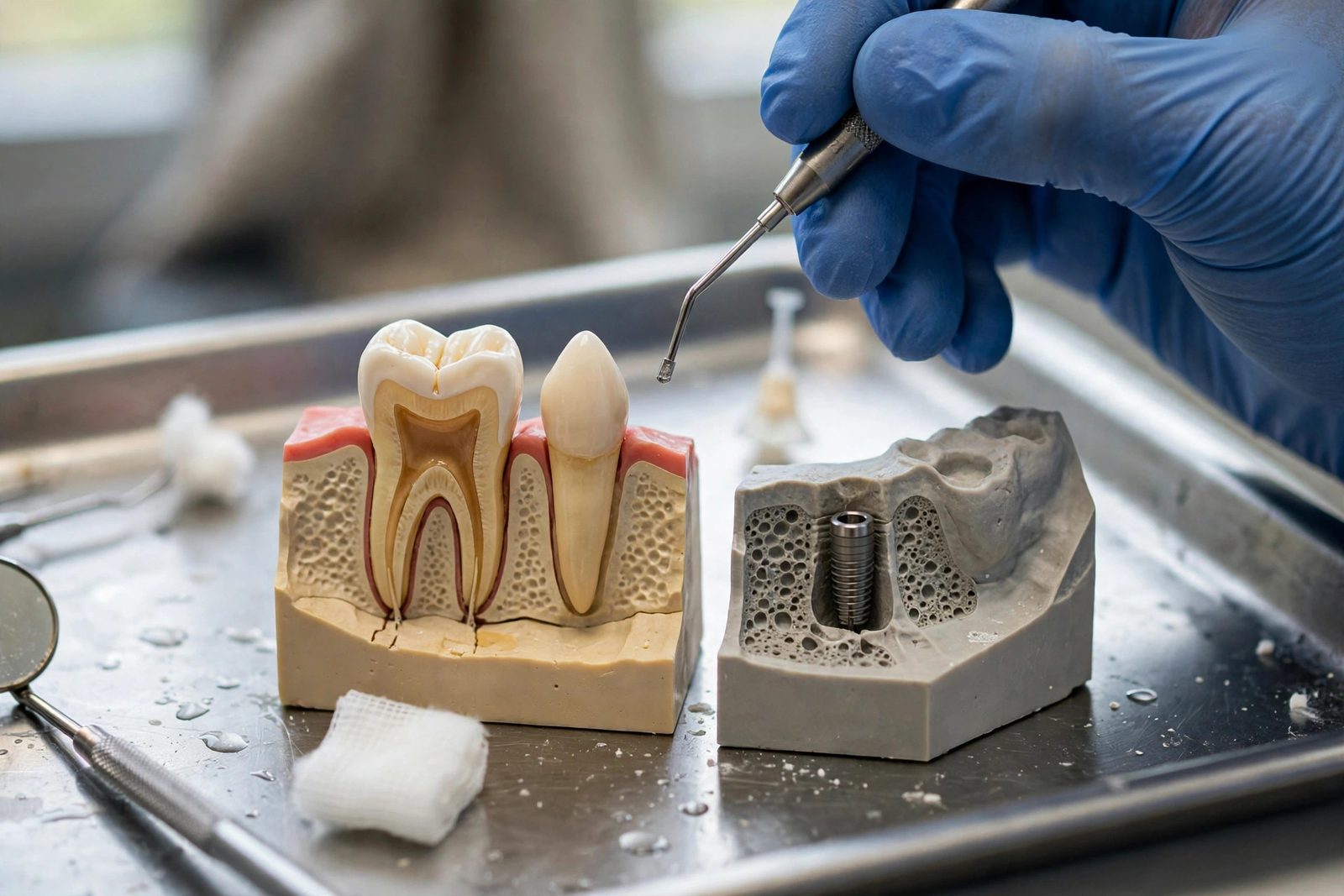
Crown vs implant, side by side
| Crown (on your natural tooth) | Dental implant | |
|---|---|---|
| What it is / how it works | The damaged tooth is shaped, and a custom cap — usually porcelain or porcelain-fused — is cemented over it, restoring its form and protecting what’s underneath. If the tooth’s nerve has died or is infected, root canal treatment usually comes first. | A titanium post is placed in the jawbone where the root used to be. Over the following months the bone fuses to it (osseointegration), and then an abutment and crown are attached, making a standalone replacement tooth. |
| Typical lifespan | Pjetursson et al., in systematic reviews of tooth-supported crowns published in Clinical Oral Implants Research, reported 10-year survival of tooth-supported single crowns of about 89% — meaning roughly nine in ten crowns were still in place at 10 years, though some needed interventions along the way. Jung et al. (2012), a systematic review in the same journal, reported 10-year survival of implant-supported single crowns of about 89% as well, with the implant fixtures themselves surviving at a higher rate than the crowns on them. Survival is not the same as “no maintenance” — both paths involve repairs over a long horizon, and neither figure is a promise for an individual case. | See the shared note in the crown column: the published 10-year survival figures for crowns on natural teeth (Pjetursson et al., ~89%) and implant-supported single crowns (Jung et al. 2012, ~89%) are strikingly similar — which is exactly why the decision turns on the condition of your tooth, not on one option “lasting longer.” |
| Maintenance and care | Brush and floss normally, with attention to the crown’s margin where it meets the tooth — decay at the margin is the main long-term threat. Night guards matter if you grind. | Brush and floss (or use interdental brushes and floss designed for implants) with the same discipline as natural teeth. Implants can’t decay, but the gum and bone around them can inflame (peri-implantitis), so check-ups and hygiene visits are not optional. |
| Effect on neighbouring teeth and jawbone | Keeps your own root in the bone, which preserves the bone around it and your natural bite sensation. Neighbouring teeth are untouched — unlike a bridge, a crown asks nothing of them. | The implant loads the jawbone like a root did, which helps slow the bone loss that follows an extraction. Neighbouring teeth are untouched — nothing is ground down to support it. Bone volume still needs to be sufficient, or built up, before placement. |
| Who it suits and who it does not | Suits a tooth with a healthy root and enough remaining structure, including after root canal treatment. Does not suit a tooth cracked below the gumline, with decay under the bone level, or with too little structure left to hold a cap — crowning such a tooth is building on a failing foundation. | Suits patients missing a tooth, or whose tooth can’t be saved, with adequate bone and healthy gums. May not suit — or may need to wait for — uncontrolled diabetes, heavy smoking, active gum disease, or insufficient bone without grafting. Some patients simply prefer to avoid surgery, which is a legitimate factor. |
| Number of visits and timeline | Usually two visits over two to three weeks (preparation and records, then fitting), plus root canal visits beforehand if needed. | Several visits over several months: planning (including 3D imaging — CBCT scans are referred out from our clinic, never done in-house), placement, a healing period while bone fuses, then the final crown. Timelines stretch if grafting is needed. |
| CDCP coverage | Crowns under the Canadian Dental Care Plan are subject to eligibility and preauthorization — coverage is never assumed, and eligibility always comes first. Dental implants are NOT covered by the CDCP. If sedation would help you through either treatment, at Mackenzie Smiles sedation means nitrous oxide only. Federal details: Canada.ca — Canadian Dental Care Plan. | |
How to choose
Work down three questions. First: can this tooth be saved predictably? If yes, saving it is rarely the wrong call. Second: if it can’t, what replaces it — and is your bone and health ready for an implant, or does something else (a bridge, a denture, or staged treatment) fit better for now? Third: what does each path ask of you over ten years — visits, maintenance, tolerance for surgery? Factors that affect cost include the number of teeth, grafting, materials, and any root canal treatment, so an exact figure follows an assessment. Call Mackenzie Smiles in Richmond Hill at (905) 237-2353 to book one.
Common questions
They fail differently rather than one being simply stronger. A crowned tooth can develop decay or root problems; an implant can develop bone inflammation around it. The published 10-year survival figures are similar (both around 89% in the systematic reviews cited above), which is why tooth condition — not strength — drives the choice.
Yes — at the margin, where the crown meets the tooth, and on the root surface if gums recede. The crown itself can’t decay, but the tooth under it can. Flossing and check-ups are what protect the investment.
Placement is done with local anaesthesia, and most patients manage the following days with standard pain relief and a soft diet. If anxiety is the barrier, talk to us — sedation at our clinic means nitrous oxide, which takes the edge off while you stay awake and responsive.
It depends on the site. Sometimes an implant can be placed the same day a tooth comes out; often a healing period of a few months gives better bone conditions. Planning uses 3D imaging, which we refer out — CBCT is never done in-house at Mackenzie Smiles.
Bone grafting can rebuild many sites, at the cost of added time. Some sites or medical situations make grafting unwise, in which case a bridge or denture may be the better answer — we’ll lay out the honest options rather than push one.
Yes, occasionally — an implant may not fuse with the bone, or may lose bone support years later, most often where gum inflammation goes untreated or smoking continues. Careful case selection, hygiene and follow-up keep the risk low, but it isn’t zero, and you should hear that before deciding.
Implants: no — the CDCP does not cover dental implants. Crowns: possibly, for eligible patients, subject to preauthorization and the plan’s rules. Eligibility comes first in every case; call (905) 237-2353 and we’ll help you check.
Often yes, if the root is sound and enough tooth remains — the combined treatment keeps your natural root and bone. If the tooth is also cracked, heavily broken down, or has a poor long-term outlook, replacement may be the wiser spend. That judgement is exactly what the assessment is for.
Mackenzie Smiles, Richmond Hill — (905) 237-2353.