

A dental crown consultation is the appointment where a recommendation gets explained — and where you get to test it with questions. Maybe your Richmond Hill dentist has found a cracked molar, a tooth with more filling than tooth left, or a root-canal-treated tooth that now needs protection. Before any treatment is booked, a proper consultation should leave you knowing why a crown is being suggested for that specific tooth, what the alternatives are, and what the process involves.
This guide walks through what happens at a dental crown consultation at Mackenzie Smiles, and the questions that make the appointment genuinely useful. Learn more about dental crowns at Mackenzie Smiles.
What happens during a dental crown consultation?
The consultation starts with the tooth itself. Your dentist examines it, checks how it responds, and reviews X-rays to see the roots, the surrounding bone and how much sound structure remains. At Mackenzie Smiles, both of our doctors — Dr. Sahel Moghtadernejad and Dr. Bahareh Aghamohammadi, general dentists in Richmond Hill — also use in-house 3D digital scanning as part of assessment and planning, which lets you see the tooth’s situation on screen rather than take it on faith. If a case ever needs CBCT 3D imaging, that imaging is arranged through referral — we will explain why and where, plainly.
Then comes the conversation: the finding, the recommendation, the alternatives, and the sequence if root canal treatment is also involved. Nothing about that conversation should feel rushed, and no treatment is started at a consultation unless you have agreed to a plan.
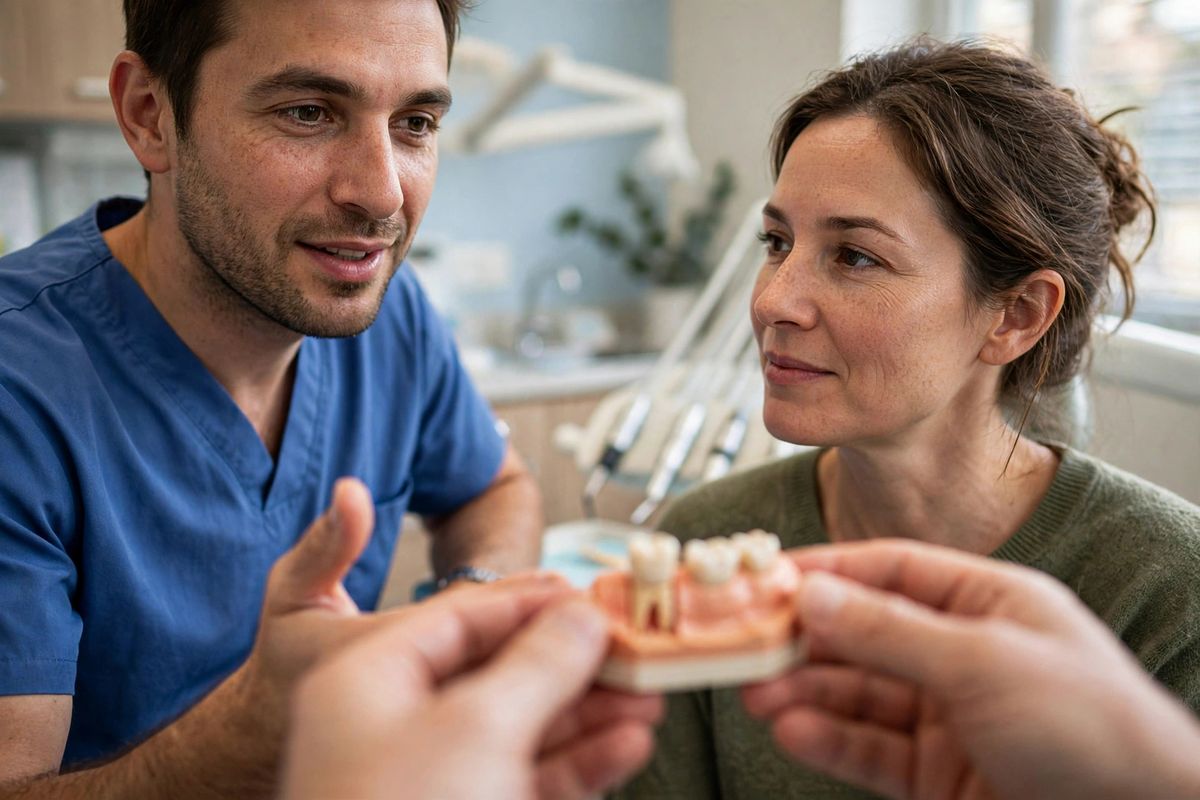
Why a crown — and why this tooth?
A crown protects a tooth that can no longer reliably protect itself: a large crack, a fracture, extensive decay, a tooth mostly made of filling, or one weakened after root canal treatment. The consultation should connect the recommendation to evidence you can see — the crack on the image, the size of the existing filling, the symptoms you described. If the explanation could apply to any tooth in anyone’s mouth, ask for the version that is about yours.
The alternatives, honestly
Sometimes a large bonded filling can rebuild a tooth for a time. Sometimes the damage runs too deep and extraction — with a later conversation about replacement — is the honest recommendation. And sometimes a crown is advisable but not urgent, and monitoring is a legitimate plan. Ask directly: “What happens if we wait, and for how long is waiting reasonable?” The answer separates a recommendation from a sales pitch. If your case involves replacing a tooth rather than crowning one, our CDCP page is not the place for that — your dentist will walk you through replacement options at the appointment; what the plan covers is addressed in the coverage section below.
Materials and the two-visit process
Crowns are typically made from porcelain or ceramic for a natural appearance, porcelain fused to metal, or metal alloys where strength matters most, such as back teeth under heavy load. Your dentist will recommend based on the tooth’s position, your bite and whether you grind your teeth — and should be able to say why in one sentence.
The process itself is usually two visits: at the first, the tooth is shaped, a scan or impression is taken for the laboratory, and a temporary crown protects the tooth; at the second, the finished crown is fitted, adjusted to your bite and cemented. If a tooth also needs root canal treatment first, that sequence is explained before anything begins, so the calendar holds no surprises.
Coverage: insurance and the CDCP
You will receive a written estimate before treatment, so your share is clear in advance — we do not publish prices, because the figure depends on your tooth, the material and your coverage. Under the Canadian Dental Care Plan, crowns require preauthorization: approval must be in place before treatment, it is not a guarantee of payment, and the plan pays according to its own fee guide, so a balance can remain. Eligibility is assessed first, always. For the practical booking checks, our guide to using the CDCP at a Richmond Hill dentist walks through them step by step.
Questions to bring with you
- Can you show me the crack or damage on my X-ray or scan?
- How much of my natural tooth will remain under the crown?
- Would a large filling work instead — and what would its limits be?
- Does this tooth need root canal treatment as well? Why?
- Which material are you recommending for this tooth, and why?
- What happens between the two visits — and what if the temporary comes off?
- What will my share be, in writing, before we start?
To book a consultation about a tooth that may need a crown, call Mackenzie Smiles at (905) 237-2353. We are open Monday to Friday, 9:00 a.m. to 7:00 p.m., and Saturday, 9:00 a.m. to 5:00 p.m.
Frequently asked questions
Usually a single appointment focused on examination, imaging and discussion. If you are already a patient and the tooth has been examined recently, the consultation may be shorter. The point is not the clock — it is leaving with the why, the options and the written estimate.
Only if the tooth’s nerve is infected, dying, or at clear risk from the extent of the damage. Many crowned teeth never need root canal treatment. If both are recommended, your dentist should explain the reason for each and the order they happen in.
The tooth is numbed with local anaesthetic during preparation, and appointments are paced to your comfort. For patients who feel anxious about treatment, nitrous oxide (laughing gas) is available at Mackenzie Smiles and may be discussed at your consultation. Some sensitivity after each visit is common; we describe it honestly rather than promise a pain-free experience.
Many crowns serve for a decade or more, but no lifespan can be guaranteed. Biting forces, grinding, decay at the crown’s edge and home care all matter. Your crown is checked at every regular exam so small problems are caught while they are still small.
For eligible patients, crowns are a CDCP service that requires preauthorization before treatment. Approval is case-by-case and is not a guarantee of payment; the plan pays according to its fee guide, so a balance can remain. Dental implants and fixed bridges are not covered by the CDCP.
Keep it, avoid chewing on that side, and call us the same day. Do not glue it back yourself — household adhesives can damage the tooth and complicate the final fitting. A temporary that comes off is a nuisance, not an emergency, unless you are in significant pain.
Almost any tooth can be crowned if enough sound structure remains to hold it and the roots and surrounding bone are healthy. Where too little structure remains, your dentist may discuss building the tooth up first — or, honestly, whether the tooth can be saved at all.
Brush twice a day and clean between your teeth as you would natural teeth, paying attention to the margin where crown meets gum. The crown itself cannot decay, but the tooth beneath it can — that margin is exactly where it happens, which is why regular checkups matter.
References
- Ontario Dental Association — patient information on crowns and restorative dentistry.
- Canadian Dental Association — patient resources on dental restorations and treatment planning.
- Royal College of Dental Surgeons of Ontario — verify any Ontario dentist’s registration on the public register.
- Canada.ca — Canadian Dental Care Plan — official eligibility and preauthorization information.
