
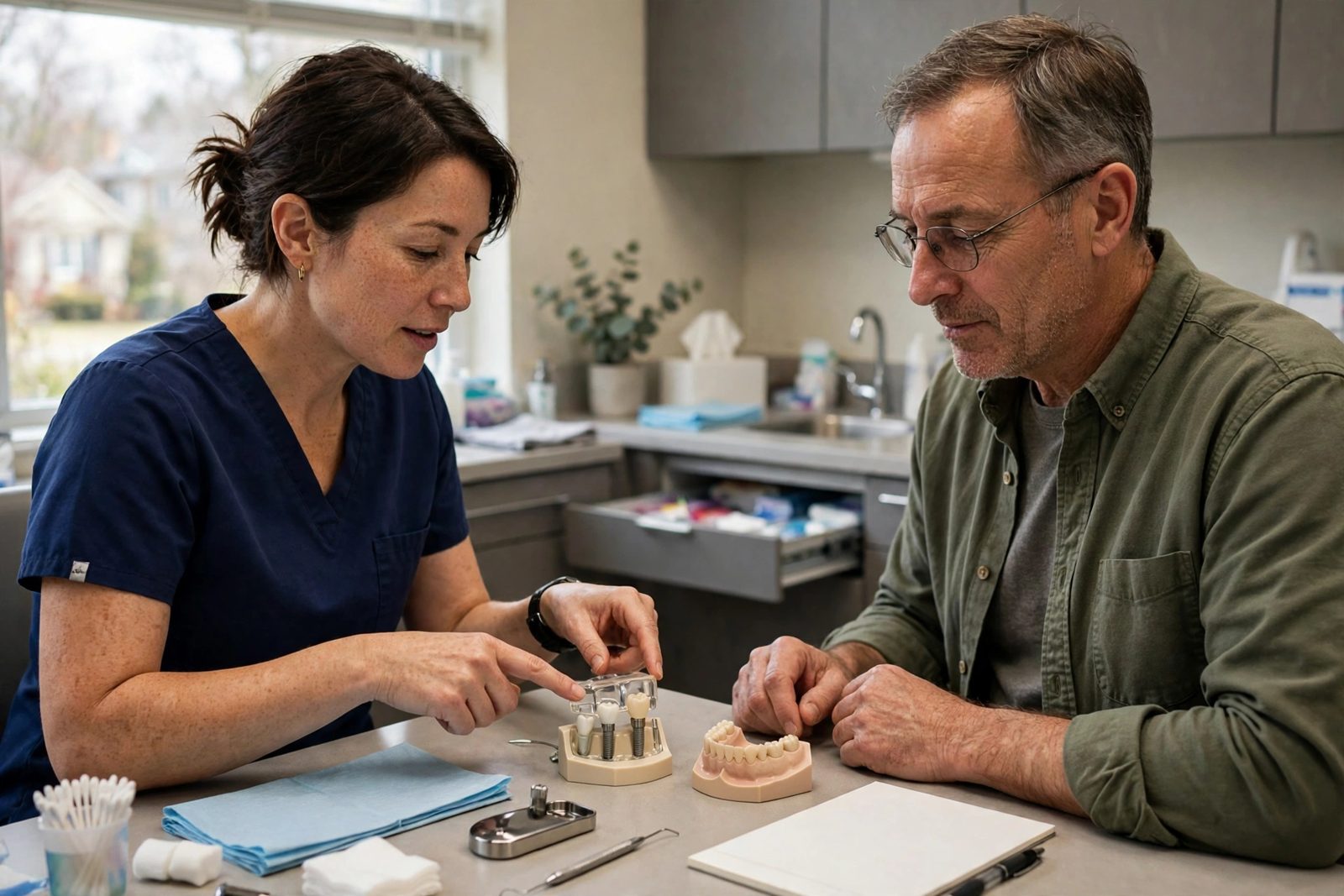
Missing a tooth and trying to decide what to do next? If you are comparing a dental implant vs fixed bridge in Richmond Hill, you are weighing two fixed ways to fill the same gap — one that stands on its own in the jawbone, and one that is supported by the teeth on either side. Neither option is right for everyone. This guide explains how each treatment works, how long each is reported to last in published research, what care each one needs, and which questions to bring to an assessment, so you can have a clearer conversation with your dentist.
In this guide:
- What is a dental implant?
- What is a fixed bridge?
- Side-by-side comparison
- How to choose between an implant and a bridge
- Frequently asked questions
What is a dental implant?
A dental implant is a small post, commonly made of titanium, that is placed in the jawbone where a tooth root used to be. After a healing period, a connector and a crown are attached on top, so the replacement looks and functions as a separate tooth. The implant does not rely on the neighbouring teeth for support.
Implant treatment is staged. It usually involves an assessment with examination and imaging, placement of the implant, a healing period while the implant integrates with the bone, and then fitting of the final crown. If 3D imaging such as a CBCT scan is needed for planning, Mackenzie Smiles arranges that imaging by referral — it is not done in-house. You can read more about the stages, suitability and risks on our dental implants service page for Richmond Hill patients.
An implant is not suitable for every situation. Bone volume, gum health, general health, smoking, and certain medical conditions can affect whether implant treatment is recommended, and bone grafting is sometimes discussed first. An individual assessment is needed before any recommendation is made.
What is a fixed bridge?
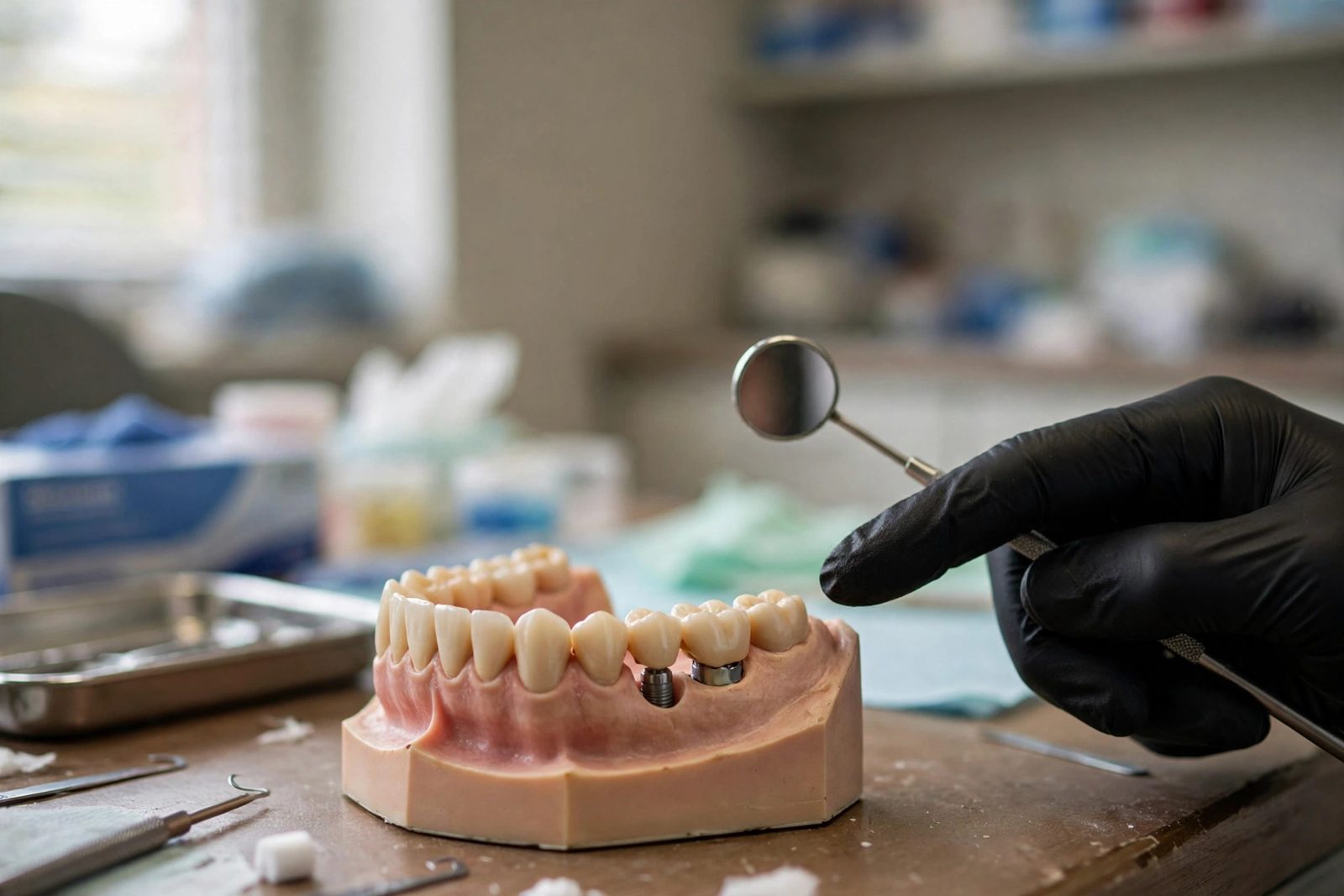
A fixed bridge replaces a missing tooth with an artificial tooth (called a pontic) that is held in place by crowns cemented onto the natural teeth on either side of the gap. Those supporting teeth are shaped to receive the crowns, and the bridge is made as one connected unit in a dental laboratory.
A bridge does not involve surgery in the jawbone, and it is usually completed in fewer visits over a shorter period than an implant. The trade-off is that healthy tooth structure is removed from the supporting teeth to make room for the crowns, and those supporting teeth then carry the load for the replacement tooth as well as themselves.
A bridge may not be a good option if the neighbouring teeth are weak, heavily restored, or missing, or if the gap is long. Your dentist will assess the supporting teeth before recommending this option. General information about tooth replacement and oral health is also available from the Ontario Dental Association.
Side-by-side comparison
The table below compares the two options across the questions patients ask most often. Lifespan figures are drawn from published systematic reviews and describe survival of the restoration in study populations — they are educational information, not a promise for any individual case.
| Aspect | Dental implant | Fixed bridge |
|---|---|---|
| What it is / how it works | A titanium post placed in the jawbone acts as an artificial root. After healing, a crown is attached to the post. The replacement is supported by the implant itself, not by other teeth. | An artificial tooth is fused between two crowns. The crowns are cemented onto the natural teeth beside the gap, so the bridge is supported by those teeth. |
| Typical lifespan | In a systematic review by Pjetursson et al. (Clinical Oral Implants Research, 2007) comparing fixed prosthesis types, the estimated survival of implant-supported single crowns — meaning the crown restoration still in function on its implant — was 94.5% after 5 years and 89.4% after 10 years. Individual results vary with health, habits and care. | In the same Pjetursson et al. (2007) systematic review, the estimated survival of conventional tooth-supported fixed dental prostheses (bridges) — meaning the bridge restoration still in function — was 93.8% after 5 years and 89.2% after 10 years. If a supporting tooth fails, the whole bridge is usually affected. |
| Maintenance and care | Brush and clean around the implant crown daily, including cleaning between teeth, and attend regular dental examinations and hygiene visits so the gum and bone around the implant can be monitored. Implants cannot get cavities, but the surrounding gum and bone can become inflamed if plaque builds up. | Brush normally, and clean under the pontic and around the supporting crowns daily using floss threaders, interdental brushes or a water flosser as advised. The supporting teeth can still develop decay, so hygiene around the crown margins matters. |
| Effect on neighbouring teeth and jawbone | Neighbouring teeth are not shaped or crowned. Because the implant sits in the jawbone and transfers chewing load to it, it helps maintain bone in the gap area, although bone loss can still occur if inflammation develops around the implant. | The two neighbouring teeth are shaped to hold crowns, which removes healthy tooth structure and means those teeth carry extra load. The bridge does not transfer load into the jawbone under the missing tooth, so the bone in the gap can gradually shrink over time. |
| Who it suits and who it does not | May suit people with enough healthy jawbone (or a plan to build it up), healthy gums, and a preference to leave neighbouring teeth untouched. May not suit people with uncontrolled medical conditions affecting healing, insufficient bone without grafting, active gum disease, or heavy smoking — an assessment is needed. | May suit people who want a fixed replacement without jaw surgery, whose neighbouring teeth already need crowns, or who need a shorter treatment timeline. May not suit people whose neighbouring teeth are weak, decayed or missing, or where the gap spans several teeth. |
| Number of visits and treatment timeline | Several visits over a longer period: assessment and planning, implant placement, a healing period that commonly spans weeks to months, then impressions and fitting of the crown. Grafting, if needed, can add stages and time. | Usually two to three visits over a few weeks: preparation of the supporting teeth and impressions, a temporary bridge while the laboratory makes the final bridge, then fitting and cementation. |
| CDCP coverage | Dental implants are not covered by the Canadian Dental Care Plan (CDCP). | Fixed bridges are not covered by the Canadian Dental Care Plan (CDCP). |
Both options also have a cost dimension, and there is no single figure that applies to everyone. Factors that affect cost include the number of teeth involved, laboratory work, whether grafting or other preparatory treatment is needed, the materials chosen, and follow-up care. Your dentist can explain the factors in your case after an assessment and provide a treatment plan for you to consider before you decide.
How to choose between an implant and a bridge
Start with the condition of the teeth beside the gap. If those teeth are healthy and unrestored, many patients prefer an option that leaves them untouched. If they already need crowns, a bridge may address two problems at once. Next, consider the jawbone: an implant needs enough bone, or a plan to rebuild it, while a bridge does not depend on the bone in the gap. Then think about timeline — a bridge is usually finished sooner, while an implant involves healing time between stages. Finally, consider long-term care: both options need daily cleaning and regular monitoring, but they are cleaned differently, and a problem with one supporting tooth affects an entire bridge.
If anxiety about dental visits is part of your decision, tell the clinic. At Mackenzie Smiles, sedation, where it is offered, means nitrous oxide only, and your dentist can explain whether it is appropriate for a given appointment. The right choice is the one that fits your oral health, your medical history and your priorities — and that decision belongs in a conversation after an examination, not in a guide like this one.
Frequently Asked Questions
Often, yes — a single missing tooth with healthy teeth on both sides is the situation where the two options are compared most directly. Which one is recommended depends on the bone in the gap, the condition of the neighbouring teeth, your general health and your preferences, all of which are assessed at an appointment.
Implant placement is surgery, so some discomfort, swelling and bruising afterwards are normal and vary from person to person. The area is numbed during the procedure, and your dentist will explain what to expect in recovery and how discomfort is usually managed. No treatment can be described as free of discomfort for everyone.
Because a bridge is one connected unit, a serious problem with a supporting tooth — such as decay, fracture or gum disease — usually affects the whole bridge. Treatment may involve removing the bridge and reassessing the area, and options at that point can include a new bridge, an implant, or another replacement, depending on what remains.
Sometimes, yes, but it is not always straightforward. Bone in the gap can shrink while a bridge is in place, which may mean grafting is needed before an implant can be placed. If you think you may want an implant in the future, raise it at your assessment so the long-term picture is part of the plan.
No. Dental implants and fixed bridges are not covered by the Canadian Dental Care Plan. If you have CDCP coverage or private insurance, ask the clinic to help you confirm what, if anything, applies to the other parts of your care, such as examinations or preparatory treatment, before treatment begins.
Because the bridge is fixed in place, you cannot remove it to clean it. Floss threaders, super floss, interdental brushes or a water flosser can be used to clean under the artificial tooth and around the supporting crowns. Your dental team can show you a technique that works for your bridge at a hygiene visit.
Implants may not be recommended, or may need to be delayed, for people with active gum disease, insufficient jawbone without grafting, certain uncontrolled medical conditions, or healing affected by heavy smoking. Some of these factors can be addressed first. Only an assessment with examination and appropriate imaging can determine candidacy in an individual case.
A fixed bridge is usually completed in two to three visits over a few weeks. An implant takes longer because the implant needs a healing period in the bone before the final crown is fitted, so the full process commonly spans several months and several visits. Your dentist can outline the expected stages for your case after assessing the area.
Still deciding? Book an assessment at Mackenzie Smiles in Richmond Hill to discuss which option fits your mouth, your health and your timeline. Call (905) 237-2353 to arrange an appointment.