
On this page
The short answer
For Richmond Hill patients missing several teeth, implants vs dentures is the decision that shapes everyday life: eating, speaking, and how much you think about your teeth. Dentures rest on the gums and come out at night. Implants anchor teeth to the jawbone — as single crowns, a bridge, or a denture that clips on firmly. Neither is right for everyone; this guide sets out the trade-offs, including the honest limits of each.
See dental implants in Richmond Hill for the treatment details behind the implant side of this comparison.
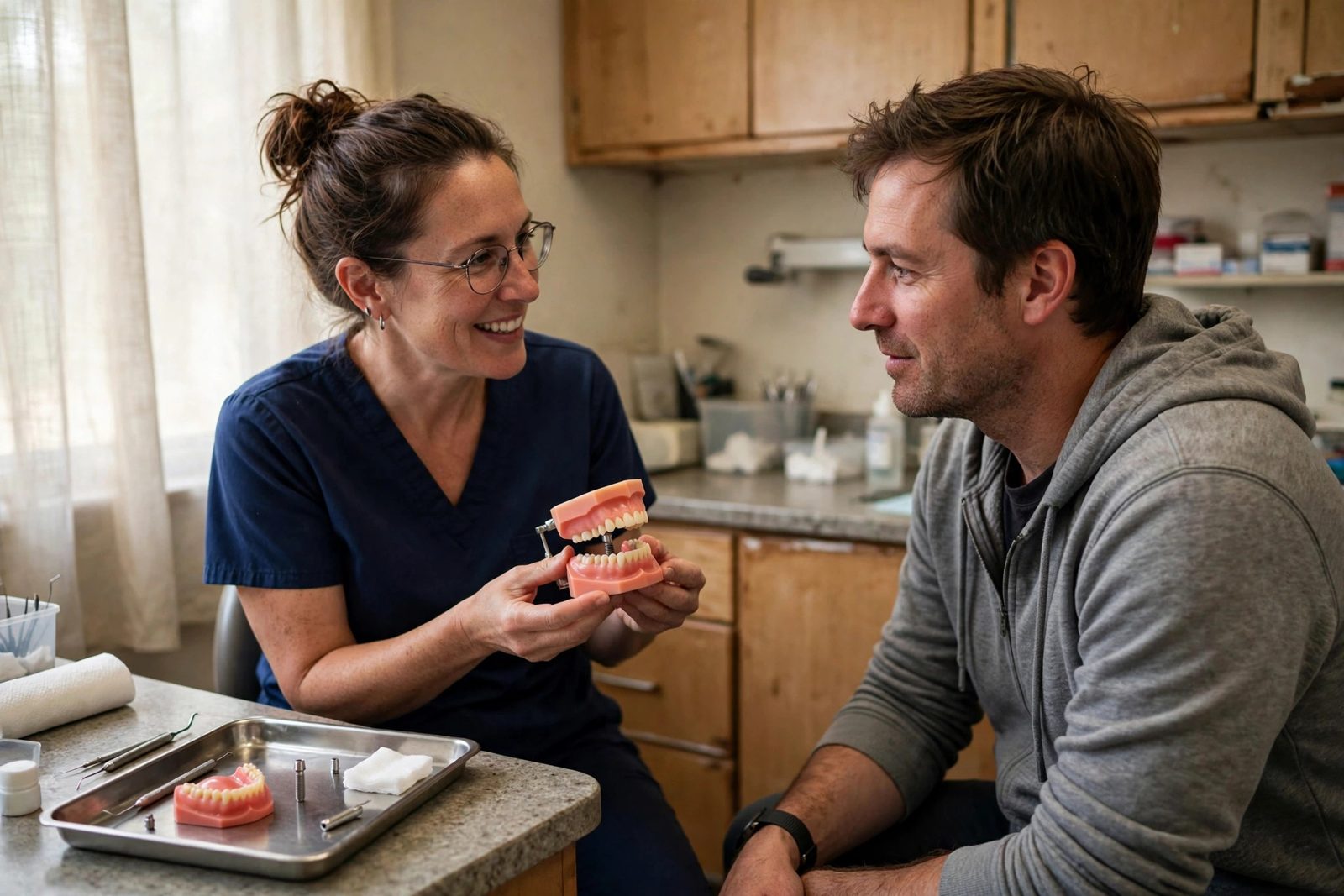
Implants vs dentures, side by side
| Dental implants (including implant-supported dentures) | Traditional dentures | |
|---|---|---|
| What it is / how it works | Titanium posts placed in the jawbone where roots used to be. They carry crowns, bridges, or a denture that snaps onto attachments — fixed or firmly held, not resting on the gum alone. | A removable appliance with false teeth on a gum-coloured base, held by fit and suction on the upper jaw and by muscle control on the lower. |
| Typical lifespan | Systematic reviews by Pjetursson and colleagues report 10-year survival around 95% for single implants (survival of the implant/restoration, not a guarantee for an individual case). The removable denture part of an implant system still wears and is renewed over time. | Relines are commonly needed as the ridge changes, and replacement is often discussed after roughly 5–10 years. These are planning ranges from prosthodontic guidance, not promises. |
| Maintenance and care | Fixed implant teeth are cleaned like natural teeth. Clip-on dentures come out daily for cleaning, and their attachments are serviced at check-ups. | Out daily for cleaning and usually out overnight. Fit problems are handled with relines or a remake — adhesive is a short-term aid, not a repair. |
| Effect on neighbouring teeth and jawbone | Implants keep loading the bone in the gap, slowing the shrinkage that follows tooth loss and helping long-term stability. | Bone under a denture gradually shrinks without root stimulation, which is why dentures loosen over the years — the lower one usually first. |
| Who it suits — and who it does not | Suits patients with adequate bone (or bone that can be rebuilt) and health that allows a minor surgical procedure, who want the firmest result. Some medical conditions and heavy smoking call for caution and a careful assessment. | Suits patients who prefer no surgery, or who need a solution in weeks. It suits less well patients who have already struggled with a moving lower denture — implants underneath are often the better conversation. |
| Number of visits and timeline | Staged over a few months: placement, healing and integration, then the final teeth. | A series of visits over a few weeks — impressions, try-in, fitting — with no surgical healing. |
| CDCP coverage | Dental implants are not covered by the Canadian Dental Care Plan. | Dentures are a service the CDCP can cover for eligible patients, subject to plan rules and preauthorization; eligibility comes first. |
How to choose
Think about the meals you avoid, the social moments you plan around your teeth, and how you feel about a surgical step. If a lower denture’s movement is your main complaint, implants underneath it are usually the single biggest upgrade. If you want teeth in weeks with no surgery, a well-made denture is a respectable answer. Cost depends on the number of implants, any grafting, and the teeth made on top — we quote exactly after an assessment rather than publishing figures that cannot fit your case.
Two clinic facts that matter for planning: at Mackenzie Smiles, sedation means nitrous oxide only, and CBCT imaging, when it is needed, is arranged through referral — we will explain both during your assessment if they apply to you. Call Mackenzie Smiles in Richmond Hill at (905) 237-2353. References: the Ontario Dental Association and the federal CDCP page.
Common questions
As few as two in the lower jaw can hold a denture firmly. The upper jaw, and fixed (non-removable) full-arch teeth, usually need more. The right number is decided from your bone and the result you want.
That is their main job in a clip-on system. The denture still comes out for cleaning, but during the day it is held by the attachments rather than by suction and muscle control alone.
Systematic reviews report about 95% of single implants surviving at 10 years. That is a group average for the implant itself; crowns and denture parts on top wear and are maintained or renewed separately.
Because the jawbone under it shrinks slowly once roots are gone, the fit changes. A reline refits the denture to today’s ridge; implants slow the shrinkage itself.
Dentures can be covered for eligible patients under the plan’s rules, with preauthorization. Implants are not covered. We can help you check eligibility at your visit.
Often yes. Sometimes the same denture can be fitted with attachments; sometimes a new denture is made for the implants. We will assess yours and tell you plainly which applies.
At Mackenzie Smiles, sedation means nitrous oxide — the mask gas — only. If that is part of your plan, we will discuss it at the assessment so you know exactly what to expect.
Fixed implant teeth clean like natural teeth. Clip-on and traditional dentures both come out for cleaning; the clip-on version adds small attachments to keep clean, which we show you how to do.